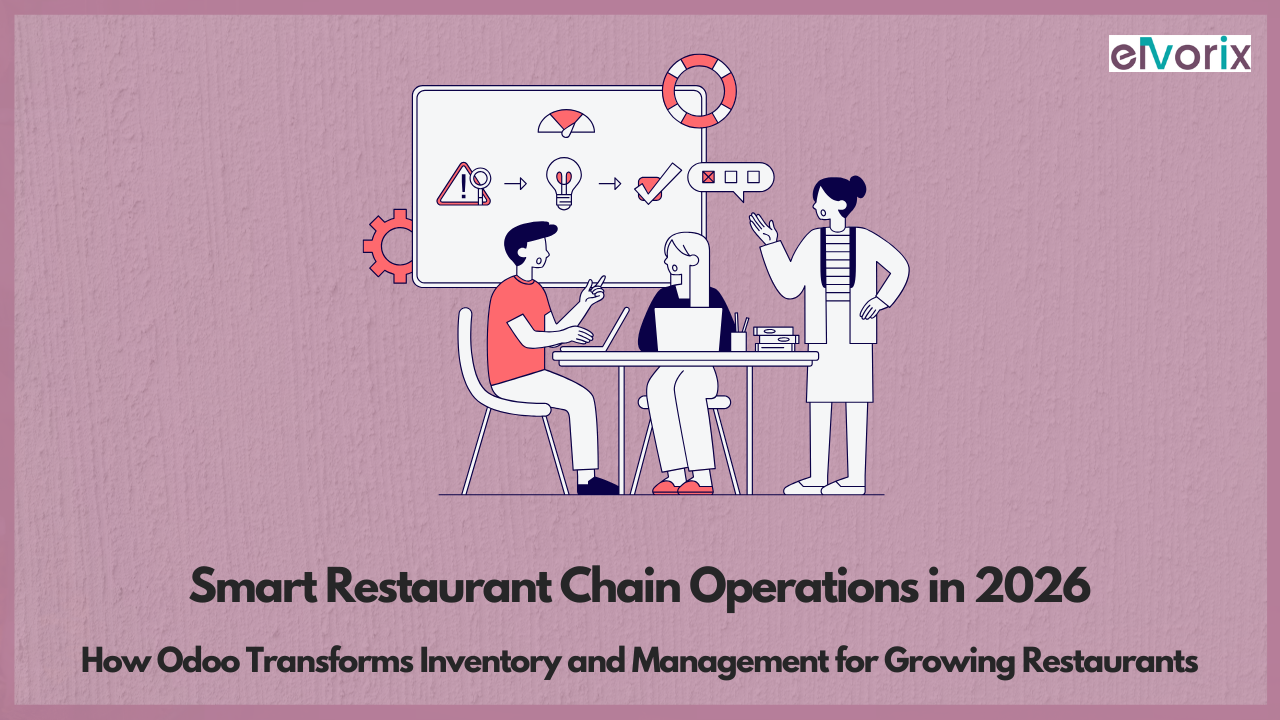
Running a restaurant in 2026 is no longer just about good food and customer service. It is about efficiency, accuracy, and real-time decision-making. From fluctuating ingredient prices to unpredictable demand, restaurants face daily operational challenges that directly impact profitability. One area where most restaurants struggle the most is inventory management.
Traditional methods like spreadsheets, manual stock counts, or disconnected POS systems fail to provide the visibility modern restaurants need. This is where restaurant inventory management software plays a crucial role. When combined with a unified ERP platform like Odoo, inventory management evolves from a reactive task into a strategic advantage.
At Elvorix, we work closely with restaurant owners, cloud kitchens, café chains, and multi-location food businesses to implement Odoo restaurant management solutions that simplify operations, reduce wastage, and improve margins.
Let’s explore how restaurants can future-proof their operations using Odoo and why it has become the preferred choice for restaurant inventory and management in 2026.
The Inventory Challenge in Modern Restaurants
Inventory in the restaurant industry is complex by nature. Unlike traditional retail, restaurants deal with perishable goods, variable portion sizes, seasonal menus, and real-time consumption. Even a small mismatch between stock levels and actual usage can lead to food wastage, stockouts, or lost revenue.
Common inventory challenges restaurants face include inconsistent stock tracking, lack of real-time visibility, over-purchasing or under-purchasing ingredients, difficulty managing multiple outlets or kitchens, manual reconciliation with POS data, and poor forecasting for demand peaks.
Without a centralized restaurant inventory management software, these issues grow as the business scales. This is exactly why ERP-driven solutions are gaining traction across the food and hospitality industry.
Why Generic Tools Are No Longer Enough
Many restaurants still rely on standalone POS systems or basic inventory tools. While these systems handle billing and order-taking well, they often fail to connect inventory, purchasing, accounting, and operations into one ecosystem.
Disconnected systems create data silos. Inventory teams don’t know what sales teams are selling in real time. Finance teams struggle with inaccurate costing. Management lacks a single dashboard to evaluate performance.
Odoo restaurant management solves this problem by offering an integrated platform where every department works with the same data in real time.
What Makes Odoo Ideal for Restaurants
Odoo is not just an ERP; it is a flexible, modular business management platform. Restaurants can start small and scale easily without changing systems. With Odoo, restaurants gain complete control over inventory, procurement, sales, accounting, HR, and reporting from one system.
Odoo restaurant management stands out because it adapts to different restaurant formats, including fine dining restaurants, quick service restaurants, cloud kitchens, food trucks, franchises, and multi-brand hospitality groups.
As an Odoo service provider, Elvorix customizes Odoo specifically for restaurant workflows, ensuring that the software aligns with real operational needs rather than forcing restaurants to adapt to rigid systems.
Inventory Management That Works in Real Time
At the core of any successful restaurant ERP lies inventory accuracy. Odoo’s restaurant inventory management software enables real-time stock updates based on sales, wastage, transfers, and purchases.
Each ingredient can be tracked by unit of measure, batch, expiry date, and supplier. This is especially valuable for perishable items where freshness directly impacts food quality and compliance.
Stock automatically reduces when dishes are sold through the POS. This eliminates manual updates and significantly reduces discrepancies. Restaurant managers can instantly see which items are running low, which ingredients are overstocked, and where wastage is occurring.
Recipe and Bill of Materials Control
One of the most powerful features of Odoo restaurant management is recipe-based inventory control. Each dish can be mapped to a bill of materials that defines exact ingredient quantities.
This allows restaurants to track actual consumption versus planned consumption. If food costs rise unexpectedly, management can quickly identify the source, whether it is portion inconsistency, supplier price changes, or kitchen wastage.
For restaurant chains and cloud kitchens, standardized recipes across locations ensure consistency in taste, cost, and inventory planning.
Smart Procurement and Vendor Management
Inventory management is incomplete without intelligent procurement. Odoo helps restaurants automate purchase planning based on real-time stock levels, minimum reorder quantities, and forecasted demand.
Purchase orders can be generated automatically and sent to preferred vendors. Supplier price lists, lead times, and performance history are maintained within the system, enabling better negotiation and vendor selection.
By integrating procurement with inventory and accounting, Odoo restaurant management ensures complete cost transparency from purchase to plate.
POS Integration for Seamless Operations
A major advantage of Odoo restaurant management is its native POS integration. Sales data flows directly into inventory and accounting modules without delays or manual intervention.
Whether orders are placed through dine-in, takeaway, delivery platforms, or self-service kiosks, inventory updates instantly. This is critical for restaurants handling high order volumes during peak hours.
The POS interface is intuitive, fast, and customizable, making it easy for staff to adapt while management benefits from detailed analytics.
Multi-Location and Cloud Kitchen Support
For restaurants operating multiple outlets or cloud kitchens, centralized control is essential. Odoo allows businesses to manage multiple locations from a single dashboard while maintaining separate stock, pricing, and reporting structures.
Inter-branch stock transfers, centralized purchasing, and consolidated reporting help restaurant groups maintain operational efficiency without losing local flexibility.
This scalability makes Odoo restaurant management a long-term solution rather than a temporary fix.
Financial Visibility and Cost Control
Inventory directly impacts profitability, and Odoo connects inventory movements with accounting automatically. Food cost percentages, margin analysis, and profitability reports are available in real time.
Restaurant owners no longer have to wait for month-end reports to understand financial health. With accurate costing and live dashboards, decisions can be made proactively.
At Elvorix, we configure Odoo reports tailored to restaurant KPIs, ensuring leadership always has actionable insights.
Compliance, Traceability, and Waste Reduction
Food safety regulations are becoming stricter globally. Odoo helps restaurants maintain batch-level traceability, expiry tracking, and audit-ready records.
Expired items can be flagged automatically, reducing the risk of serving unsafe food. Waste tracking features help identify recurring issues and implement corrective measures.
By reducing food waste and improving compliance, restaurants not only save costs but also strengthen brand reputation.
Customization and Industry Expertise with Elvorix
While Odoo is powerful out of the box, its true potential is unlocked through expert implementation. At Elvorix, we specialize in tailoring Odoo restaurant management solutions based on each client’s operational model.
From custom inventory workflows and POS enhancements to advanced reporting and third-party integrations, we ensure the system works exactly the way your restaurant operates.
Our industry-focused approach ensures faster adoption, minimal disruption, and measurable ROI.
Preparing Restaurants for the Future
The restaurant industry in 2026 is driven by data, automation, and customer experience. Restaurants that rely on disconnected tools struggle to keep up, while those using integrated ERP systems gain a clear competitive advantage.
Investing in the right restaurant inventory management software is no longer optional. It is a strategic decision that impacts cost control, scalability, and long-term growth.
Odoo restaurant management provides the flexibility, visibility, and control restaurants need to thrive in an increasingly competitive market.
Final Thoughts
Restaurants that master inventory management outperform those that don’t. With Odoo, inventory becomes a strategic asset rather than a daily headache.
If you are looking to streamline operations, reduce wastage, and gain complete control over your restaurant business, Odoo is the platform to build on and Elvorix is the partner to guide you through every step of the journey.